

Free demo
Insight report
Running cost, model choice and the effect on junior staff, for the people who approve AI
Download the 2026 report (PDF, 17 pages)Working demo
The pattern to ask of any AI supplier: every answer quoted with its source
Open the Knowledge Desk demoLead the change. Use the tools.
What we do
Practical AI capability at leadership level.
Leaders need experience of the tools as well as a view of the risks. A convincing demo does not explain the full cost, who checks the output or how a team will use it after launch.
We combine hands-on work on briefing, planning, research and management reporting with decisions about adoption. Directors practise challenging an answer, comparing a proposal with an alternative and setting responsibilities for the team. Legal and data protection decisions stay with the people authorised to make them.
Briefings and workshops for the people who answer for AI
The board briefing is for the whole board. The other sessions are for the directors and smaller groups who will use, own, cost, contract, record and staff each AI use. The chair or chief executive agrees the length, the attendees and the place of each before it is booked.
AI in a director's working day
Practise preparing a decision brief, summarising approved papers and challenging a plan with an AI assistant.
- Use approved sources and suitable sample papers
- Ask for assumptions, gaps and alternative explanations
- Verify the evidence behind a recommendation
- Create reusable instructions for planning and reporting
Board AI briefing
Brief the board or trustees on what AI can and cannot do in your organisation, the risks it carries and the decisions they will be asked to take. We work from the tools your staff already use and the proposals already on the table, and send pre-reading beforehand.
- Pre-reading drawn from 'What an answer costs: the energy, the people, and who pays'
- How a large language model produces an answer, and where it fails
- The ONS and DSIT figures on AI use and AI risk practice in UK organisations
- A sample-data demonstration of the pattern to ask for: answers quoted with their source, and a plain 'not covered' when the documents are silent
- A written note the board can minute
AI governance workshop
Set ownership, risk appetite and the approval route for AI use with the people who will own it. We draw on ISO/IEC 42001, the NIST AI Risk Management Framework and the ICO's guidance on AI and data protection, and leave a governance outline to adopt or amend. Your advisers sign off anything with legal effect.
- A named owner for AI decisions, with the thresholds that bring a use back to the board
- A risk appetite statement for AI in the board's own words
- An approval route for new tools and for AI features added to software you already use
- An acceptable-use outline for staff, ready for the responsible AI session to build on
- For public bodies, the AI Playbook for the UK Government and the Algorithmic Transparency Recording Standard; for charities, the Charity Commission's published position on trustees and AI
AI business case review
Test an AI proposal for its full running cost, its lock-in and how its benefits will be measured, before the board approves it. We read the case with you, put the questions to its authors and record what they could not answer.
- Running cost at expected volume, including per-use and model charges
- Model choice and routing, following the cost findings in 'What an answer costs'
- Exit terms, data return and the cost of switching supplier
- A baseline and a measure for each claimed benefit
- For public bodies, a read against the Green Book's five-case model
AI supplier questions
Put the same questions to every AI supplier before the contract is signed, and record the answers so the board can compare them and revisit them at renewal. We draft the questions with you, read the replies and mark where a reply and the draft contract disagree, for your legal advisers to check.
- Whether your prompts and files train the supplier's models, and on which account tier
- Retention periods, deletion on exit and the format your data comes back in
- Sub-processors and processing location, including transfers outside the UK
- Liability, indemnities and who owns the outputs
- Location-based emissions for the region that serves your account
AI risk register and board reporting
Add AI to the risk register with owners, controls and review dates the audit and risk committee can follow. Decide what the board sees at each meeting and what triggers a report between meetings.
- Example entries for the uses you have approved
- Risk sources from ISO/IEC 23894 and the trustworthiness characteristics in the NIST AI RMF
- An incident route that joins your personal data breach process under UK GDPR Article 33
- A one-page board report covering uses, incidents, overrides and running cost
- For public bodies, entries set out in the terms of HM Treasury's Orange Book
Workforce and change planning
Plan the skills, role changes and staff consultation that adoption will need, before the tools arrive. Set out who is affected, what they need to learn, and how and when they will be told.
- A task-level map of the roles each approved use changes
- A training sequence built from the AI foundations and role-based sessions
- A communication plan for staff and, where they exist, recognised unions or employee forums
- Consultation points for your HR and legal advisers to confirm
- The questions on junior hiring raised in 'What an answer costs'
What you get
What the board owns, tests and records
- Directors use an approved assistant on a real leadership task and check its work.
- An adoption plan with an owner, a trial task and a way to assess value.
- Clear questions about supplier terms, data access, running costs and workforce impact.
Check it yourself
Board questions, by NIST AI RMF function
The NIST AI Risk Management Framework sorts AI risk work into four functions: Govern, Map, Measure and Manage. We have turned a selection of its outcomes into yes or no questions a board or trustees can answer about their own organisation. Each source line names the subcategory, or the UK rule, the question comes from.
0 of 13 in place
Nothing you tick is sent anywhere. It stays in this page.
The NIST questions paraphrase outcomes in NIST AI 100-1, the AI Risk Management Framework 1.0 (January 2023), a voluntary framework published by the US National Institute of Standards and Technology. Answering them is not a compliance assessment, and your advisers sign off anything with legal effect.
How it runs
Before, during and after the board meeting
- 01
Scope call
Agree with the chair or chief executive which decisions are coming to the board, which AI tools are already in use and which proposals are on the table.
- 02
Pre-reading
Send each member a short pack: the relevant sections of 'What an answer costs', the ONS and DSIT figures, and your own list of tools and proposals.
- 03
Board session
Work through the checklist and one live proposal, and record each answer, gap and owner as the board agrees it.
- 04
Written note
Send the board a note it can minute: the answers, the gaps, the owners, and the documents to adopt, amend or reject.
Read and try
Read the research. Open the demo.
Insight report
What an answer costs
Written for the business owners and leaders who decide on AI, it covers running cost and model choice, client data on business accounts, and the effect on junior staff, and it is the pre-reading for the board briefing.
Download 'What an answer costs' (PDF, 17 pages)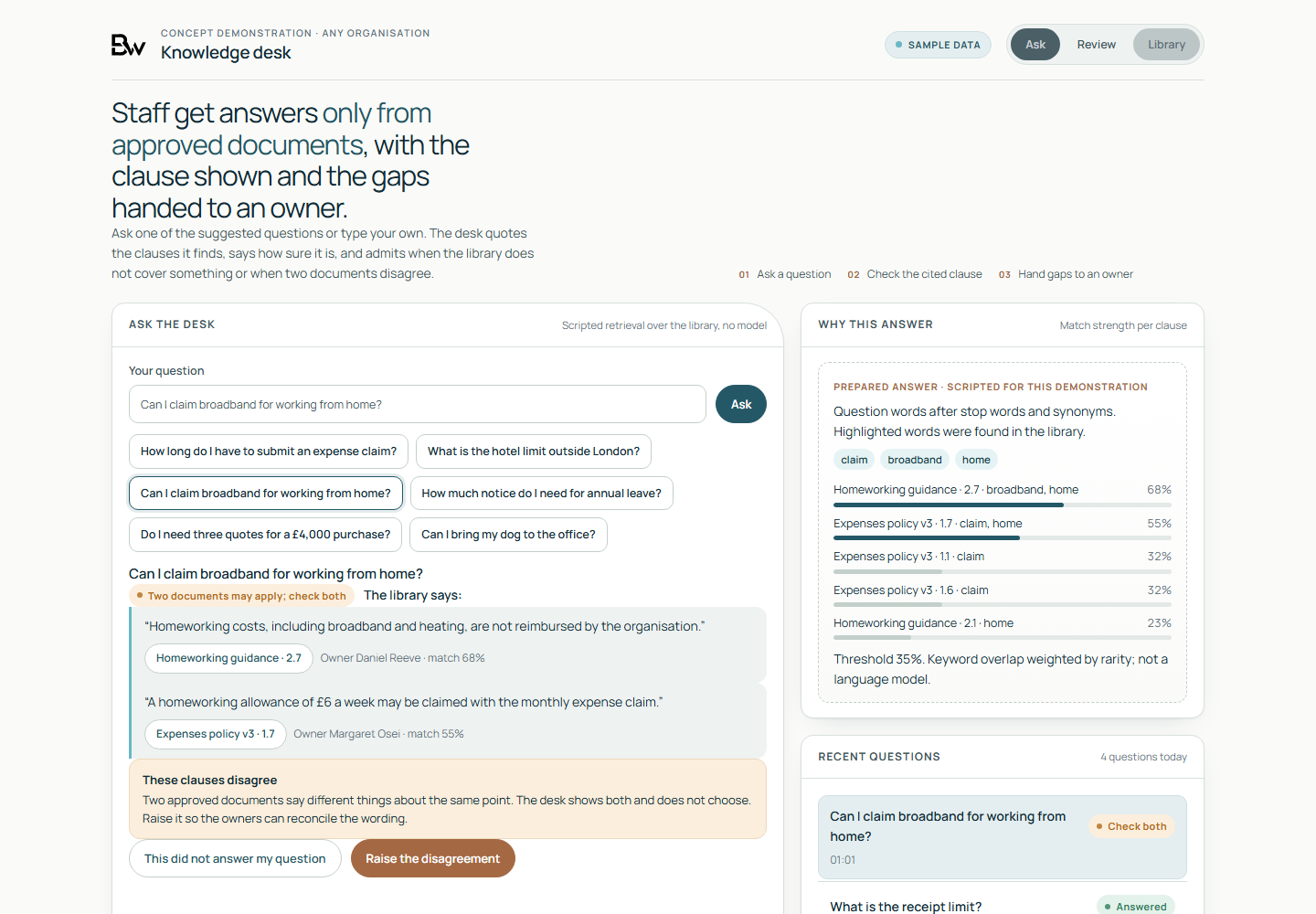
Working demo, on sample data
- A staff question answered with the clause quoted and its source document named.
- A plain 'not covered' answer when the approved library is silent.
- Gaps and challenges handed to the document owner for a decision.
Worth asking first
- Who on the board or among the trustees takes explicit responsibility for AI risk, and is it written down?
- Could you list today every AI tool in use, including the AI features inside software you already pay for?
- If a supplier claimed a forty per cent saving, what baseline and measure would you ask for?
- Which of your AI suppliers may train on the prompts and files your staff enter, and on which account tier?
- What could you show the ICO today about how personal data is used in your AI tools?
Talk to us if
- A supplier has proposed an AI tool and the board is being asked to approve the spend.
- Staff are using AI tools and there is no approved list or written policy.
- A software renewal adds AI features and the decision to switch them on is still open.
- Your auditors, funders or regulator have asked how AI risk is governed.
- The risk register has no entry for AI, or one entry that covers everything.
- You are planning role changes linked to AI and need to decide how and when to tell staff.
Questions
Questions buyers ask
Do directors get hands-on time with the tools?
Yes. The session combines a practical leadership task with decisions about value, ownership and responsible adoption.
Can owners review how AI is being used?
We can help define useful reporting on tasks and shared outputs. The available features depend on the platform. Any staff monitoring needs a defined purpose, appropriate access and retention, clear information for staff and review by your HR and data protection advisers.
Is this legal advice or certification?
No. We teach practical methods and help you prepare questions and working documents. Your advisers review legal decisions; we do not certify compliance.
What do leaders keep afterwards?
The exercises, reusable instructions and a record of adoption decisions, open questions and owners agreed in the session.
Build confidence from direct experience.
Bring one leadership task and one AI decision. We will shape a practical session around both.
Discuss leadership AI training