

Free demo
AI that acts, with a named person accountable for what it does
We start from the work, not the tool. We list the tasks an agent could take on, set how far each may act, test the strongest on your own past cases and write down what happens when it gets something wrong. The answer may be to build, to buy or to stop.
How far AI should act
Set the boundary. Keep the oversight.
An AI agent completes steps in your systems, such as updating a record or raising an order, rather than only answering a question. For each task we set how far it may go. Each level keeps the controls of the levels below it and adds its own.
Choose a level to see where the person stays involved.

Illustrative workflow · Level 1
WorkflowAI suggests
Human oversightPerson decides
Human oversightPerson acts
A named person remains accountable.
Suggest
The tool proposes, and a person decides and does the work: a suggested category on an incoming request, or a passage found in a policy library.
Explore the controls
Needs an approved tool on a business account, data rules for prompts and uploads, and a periodic check of suggestions against what people decided. We build at this level.
The four levels are our working scale, not a published standard. Your advisers sign off the legal position at each level.
Ways to work with us
One decision, or a continuing conversation.
Each stands alone. Neither assumes you will build with us, and a build is always quoted separately. We explain any commercial relationship that could affect a recommendation before you decide.
One-off
Consultation, then a build if the case holds
A fixed piece of work on one team or process. It ends in a written verdict to build, buy or stop, judged against criteria agreed before we start. If the verdict is to build, our development team can build it at the level of autonomy set here, or you can take the plan to another supplier.
What you receive
- The team's tasks listed with their volume, the judgement each needs and the cost of an error
- A level of autonomy, and the rules that go with it, for each task on the shortlist
- A measure of how the current process performs, and a test on a sample of your own past cases
- A written plan for when the agent is wrong: how an error is caught, who puts it right and when the agent is switched off
- The data, access and supplier checks each use depends on, with DPIA screening where personal data is involved
Not included: the build, which is quoted separately, and legal sign-off, which stays with your advisers.
See the agentic AI assessmentMonthly
Monthly AI advisory
A named adviser for the AI you run and the AI you are considering. Each month you receive a short written brief on what changed and what to do about it, and the agents you run are checked again against the test cases agreed for them. The scope is agreed with your team before work begins.
What you receive
- A written brief each month on changes in AI, regulation and your suppliers, each marked adopt, stop, watch or no action
- Your AI register kept current: every tool and agent, its owner, the data it touches and its next review date
- The agreed test cases run again each month against every agent in scope, with any change in results reported
- A review of any incident you report, including whether the agent's level of autonomy still fits
- An agreed route for questions, a monthly call, and a quarterly review written for your board
Not included: building, round-the-clock monitoring, legal advice, and audit or certification of any system, including those we built.
See monthly AI advisoryCapabilities
From the agent to the ground it runs on
Start with the agentic AI assessment or monthly advisory. The other four look at what an agent depends on: the process it joins, the systems it touches, the access it is given and the investment case around it. Each can be commissioned on its own.
Agentic AI & adoption
Decide which tasks an AI agent should take on and how far it may act, test the strongest on your own past cases, and plan for when it is wrong.
See agentic AI & adoptionMonthly AI advisory
A named adviser each month: a written brief on what changed and what to do, your AI register kept current, and your agents checked again against agreed test cases.
See monthly AI advisoryWorkflow & efficiency reviews
Follow one process through the desks and systems it passes, and show where its time goes before anyone decides what to change.
See workflow & efficiency reviewsArchitecture & integration planning
Map how your systems connect, decide which one owns each record, and keep the reason for every decision.
See architecture & integration planningCyber security
Find the gaps in your accounts, systems and suppliers, close them in order of risk, and prepare your evidence for Cyber Essentials.
See cyber securityTechnology strategy
Set the realistic options side by side, cost each one over five years including the way out, and decide before a renewal or a deadline decides for you.
See technology strategyWhere consulting starts
See where software acts and where a person decides
Consulting starts with a free demo too. Before you commit budget, we turn one workflow into a working demo, so the conversation about what AI should do, and where a person signs off, is about something you can click through rather than a slide. It also helps separate what needs new software from what better use of your current tools would fix. The demo uses sample data and is not the finished product, and it is not free production development.
Tell us about one workflow
A short call or message: what happens today, who is involved and where it gets stuck.
We build a working demo
A small, clickable version of that workflow with sample data, shaped around the way your organisation works.
Walk through it together
We show you the demo, you challenge it, and we agree whether and how to take it further.
An example demo
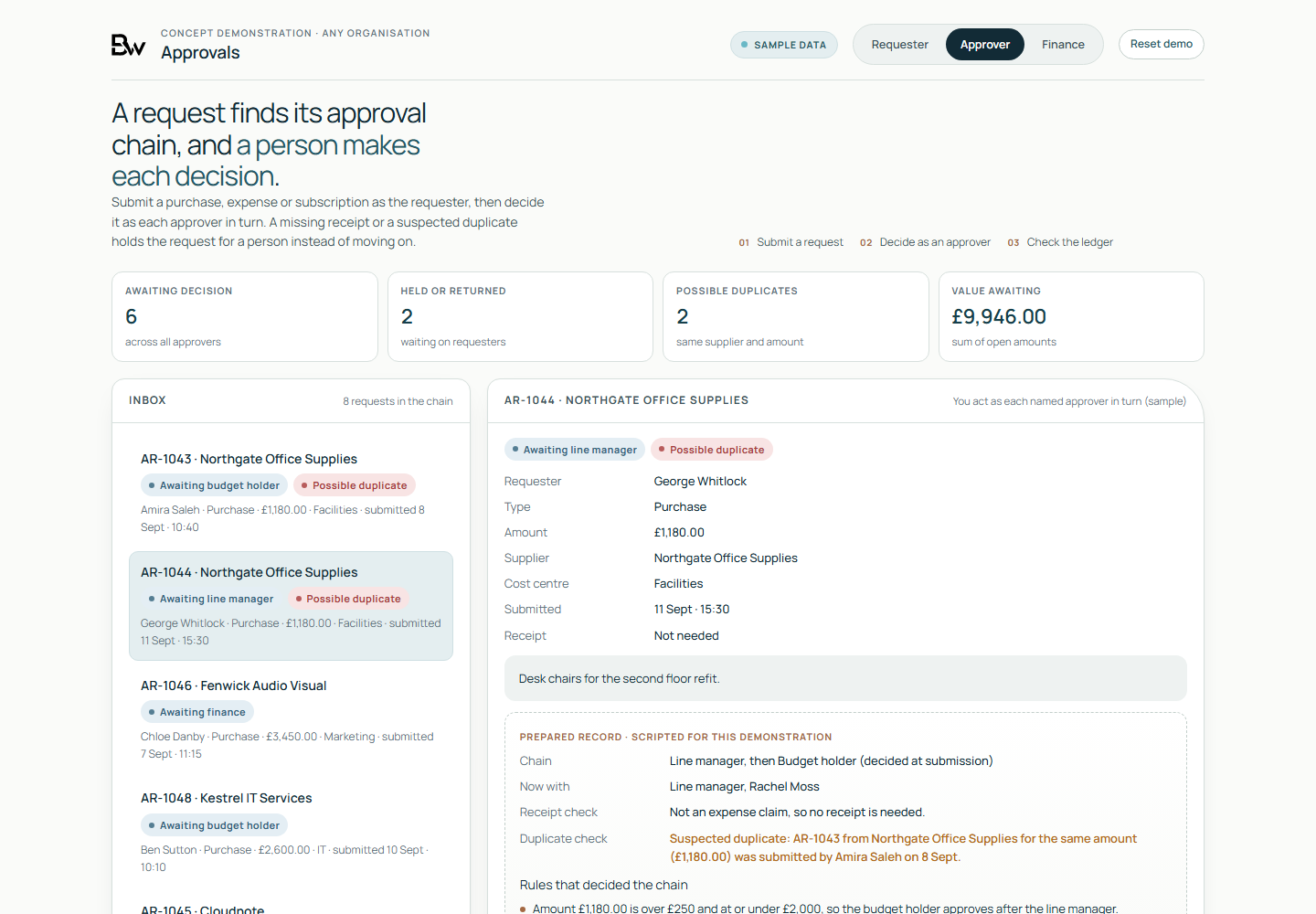
Demo · Approvals and spend control
Approvals
Submit a purchase, expense or subscription and watch it find its approval chain from illustrative thresholds, then decide it as each approver in turn. A missing receipt or a suspected duplicate holds the request for a person, and finance sees totals by cost centre against budget.
- Requester
- Approver
- Finance
Approvals shows how a consulting question, such as why purchases take two weeks to sign off, becomes a visible chain of rules, owners and holds: the chain any agent acting on those requests would have to follow.
After the demo: how a consulting engagement runs.
Compare the options on equal terms
The right decision may be to improve an existing tool, configure an established product or build around a specific need.
Improve what you have
- Useful when
- The current tool fits the task, but its setup or everyday use needs attention.
- Test first
- Try a better request, configuration or working practice against a real constraint.
- Keep in view
- Limits of the current system and the work that still happens around it.
Buy and configure
- Useful when
- An established product supports the common need and its important variations.
- Test first
- Run a representative journey, including an exception and the required integration.
- Keep in view
- Licensing, configuration, migration and ongoing responsibility.
Build around the need
- Useful when
- A distinctive workflow or experience needs a considered bespoke response.
- Test first
- Prototype the smallest complete journey and its hardest dependency.
- Keep in view
- Delivery, running costs, future changes and the ability to hand over.
From the task list to a verdict
Map the work and what an error costs
List the tasks an agent could take on, with their volume, the judgement each needs and what a mistake would cost. Measure how the current process performs, so any change can be judged against it.
Set the level and test it
Set how far AI may act on each task on the shortlist, check the data, access and suppliers beneath it, and test the strongest candidate on a sample of your own past cases.
Decide what happens next
Deliver a written verdict to build, buy or stop, with the plan for when the agent is wrong. Build with our development team, take the plan to another supplier, or keep us on as monthly advisers.
Guides and research
Reading for your next decision
Practical briefs on choosing a supplier, protecting your organisation and understanding the cost of AI.
Brief · July 2026
Before you sign
Brief · June 2026
Cyber security for small organisations
Insight report · September 2026
What an answer costs
Worked examples
Demonstrators in practice
Working demos built on sample data. They show the approach, not client results.
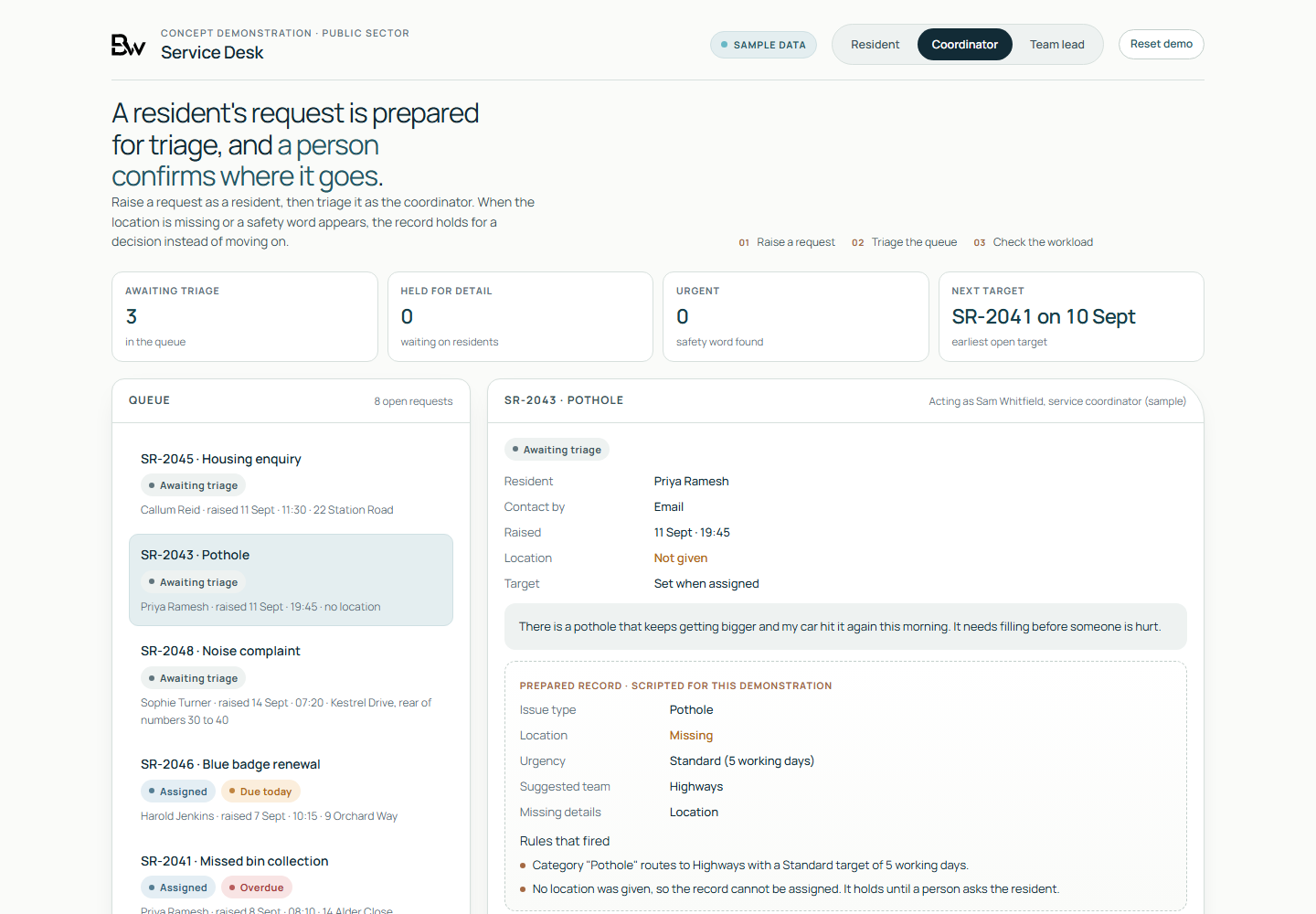
Demo · Resident services
Service Desk
Raise a resident request, then triage it as the coordinator from a prepared record that shows the rule that fired.
Try Service Desk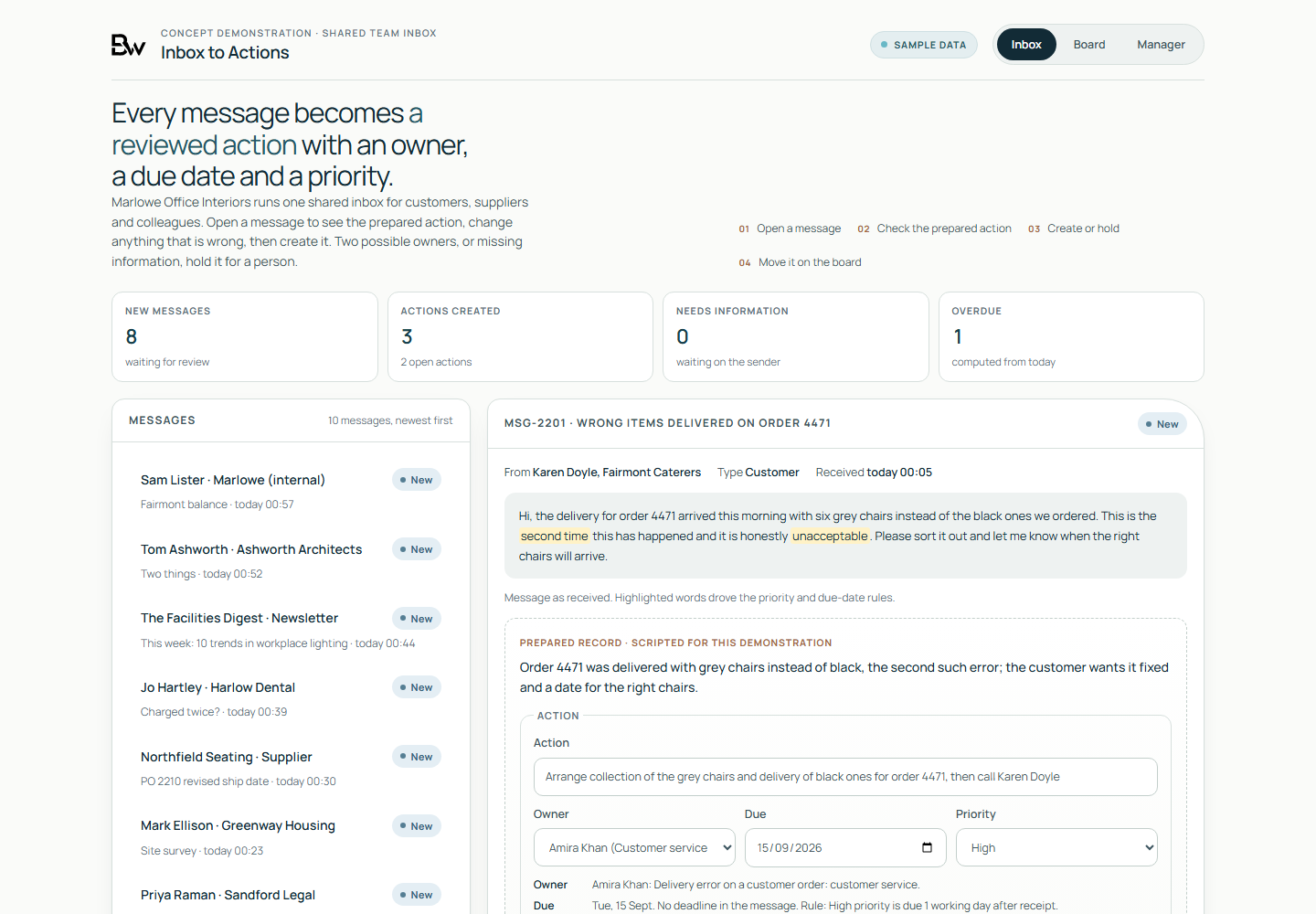
Demo · Shared inbox
Inbox to Actions
A shared team inbox where each customer email, supplier message or internal request is prepared as an action with an owner, a due date and a priority, then reviewed before it reaches the board.
Try Inbox to Actions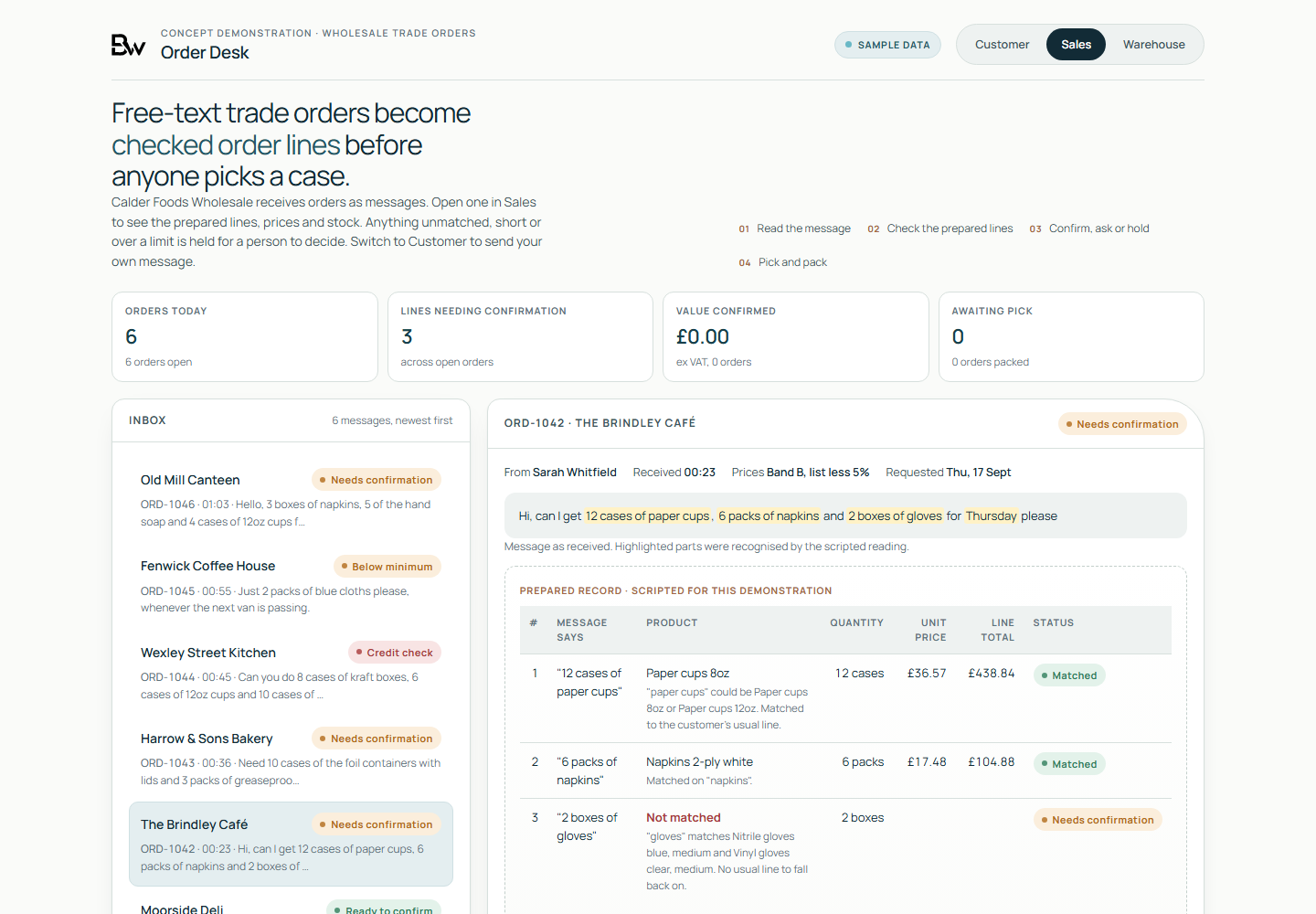
Demo · Order handling
Order Desk
A wholesale desk that reads free-text trade orders into priced, stock-checked lines before anything is picked.
Try Order DeskRelated insights
Related research

Trust and oversight · September 2026
When can you trust AI?
What the evidence says about AI errors, and the checks that let an organisation rely on an AI-assisted result.
Read the report
Business readiness · September 2026
AI readiness starts before the rollout
What the evidence says about preparing for AI: the starting point, the people, and a first step small enough to learn from.
Read the report
AI outlook · September 2026
What comes next for AI?
What has changed, what has not changed yet, and the decisions that hold up whichever way AI develops.
Read the report